Christmas in Italy: Italian Vocabulary and Traditions for the Holiday Season
On this page
Christmas is definitely a big deal in Italy, so if you’re learning Italian or simply want to know how to greet your Italian friends on Christmas, this article is for you.
Here we’ll talk about Italian Christmas and New Year words and phrases, and we’ll go through a little bit of Italian Christmas traditions.
Let’s start!
Let the Christmas Festivities Begin!
Many families put up Christmas decorations around 8 December, the public holiday of the Immaculate Conception. Others begin earlier or later; there is no single household timetable.
At this point, you’ll start seeing lots of Christmas ornaments in homes, shops, and on the streets. Christmas markets also open, and Christmas trees now adorn the different piazzas. Christmas is in the air!
Here are some Italian vocabulary you’ll come across at this time.
Italian Christmas Vocabulary List #1
| il giorno dell’Immacolata Concezione (or simply l’Immacolata) | the Day of the Immaculate Conception |
| gli addobbi | ornaments |
| l’angelo | angel |
| l’albero di Natale | Christmas tree |
| palline dell’albero di Natale | Christmas baubles |
| Gesù bambino | Baby Jesus |
| Maria (Madonna) | Virgin Mary |
| San Giuseppe | St Joseph |
| pastore | shepherd |
| neve | snow |
| fiocco di neve | snowflake |
| pupazzo di neve | Snowman |
| la renna | reindeer |
| slitta | sleigh |
| la ghirlanda | wreath |
| l’agrifoglio | holly |
| campana | bell |
| elfo | elf |
| la candela | candle |
| il vischio | mistletoe |
| bastoncino di zucchero | candy cane |
| il presepio | nativity scene |
| presepe vivente | a living nativity scene |
| mercatini di Natale | Christmas markets |
Christmas Day Approaches!
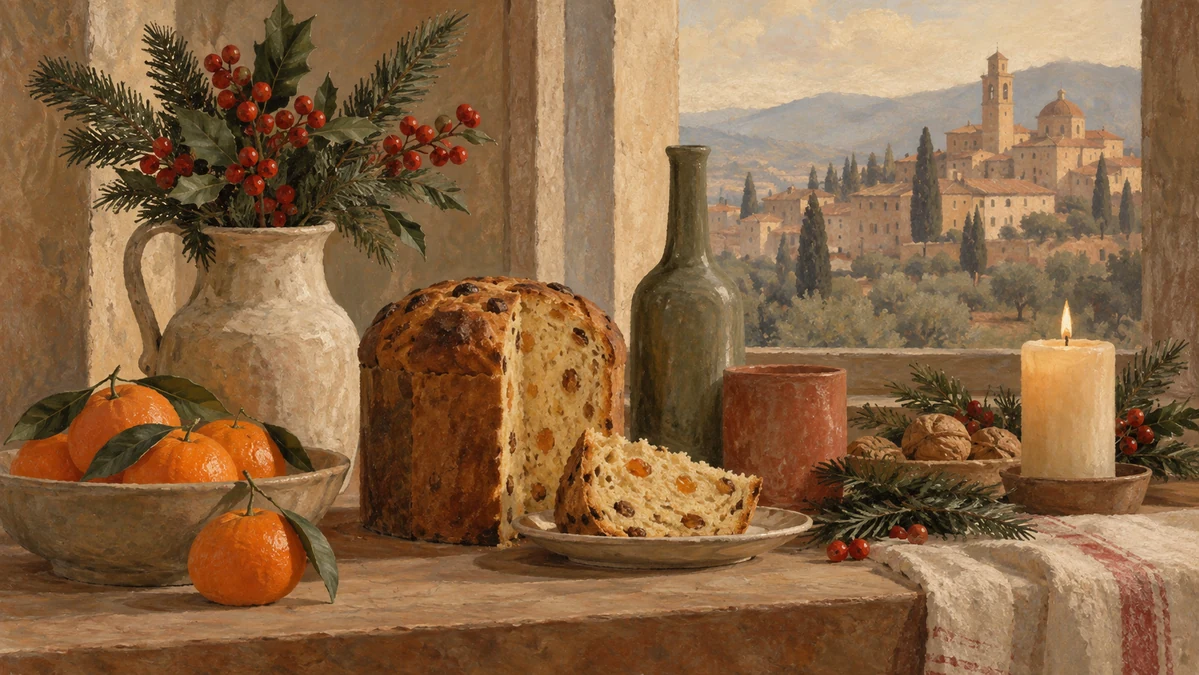
As the days become more and more festive, you can practically smell the Christmas atmosphere in the air! Or is it just some chestnuts, mulled wine, or freshly baked Christmas breads? Probably all.
In the days leading up to Christmas, some towns host carol singing or performances by zampognari, traditional bagpipe players. The Christmas novena is a nine-day devotional observance.
This is the perfect time to catch up on some Christmas shopping, so ready your Christmas list, get to baking some cookies, or head over to the Christmas markets to soak in some of the joyous atmosphere.
Italian Christmas Vocabulary List #2
| Castagne | chestnuts |
| caldarroste | roasted chestnuts |
| un bicchiere di spumante | a glass of sparkling wine |
| il pandoro | a soft, star-shaped Christmas cake |
| il Panettone | a bread-type Christmas cake with raisins and candied fruit |
| il torroncino | little nougat |
| il torrone | nougat (often made with nuts; chocolate varieties also exist) |
Who brings the gifts?
Gift-bringing traditions vary by family and region. Children may associate presents with Babbo Natale, Gesù Bambino, San Nicola, Santa Lucia or la Befana.
Babbo Natale is widely known in Italy, alongside older local gift-bringing traditions. A family may celebrate more than one of these occasions.
San Nicola is celebrated on 6 December; in places with a gift-giving tradition, presents may arrive on the night of 5–6 December.
In parts of northern Italy, Santa Lucia brings gifts on the night of 12–13 December. Her feast day is 13 December.
There’s one more gift-giving personality in Italian traditions: la Befana. La Befana is some sort of an Epiphany witch who flies in the sky and brings presents to children on the day of the Epiphany. The naughty kids get a lump of coal, too!
Now here are some more vocabulary for this part of the holiday season.
Italian Christmas Vocabulary List #3
| la novena | a nine-day devotional observance |
| l’atmosfera di Natale | Christmas atmosphere |
| il regalo | gift |
| regali di Natale | Christmas presents |
| auguri | wishes |
| Gesù Bambino | Baby Jesus |
| Babbo Natale | Santa Claus /Father Christmas |
| San Nicola | St. Nicholas |
| Santa Lucia | St. Lucy |
| camino | chimney |
| caminetto | fireplace |
| Polo Nord | North Pole |
| calza | stocking |
| la casa di marzapane | marzipan house |
| zampognari | bagpipers |
Christmas is finally here!
The main Christmas events begin on Christmas Eve, where families sit down and have dinner that is either lean or elaborate, depending on which traditions they follow. Some Italians prefer a light, no-meat dinner on Christmas Eve while others would go for multiple courses of fish dishes!
Some families attend Christmas Mass, sometimes at midnight or earlier in the evening, and may celebrate with sparkling wine and Christmas cakes. Customs vary.
On Christmas Day, Italians would spend it with family—opening presents, playing cards, watching Christmas movies, and eating a hearty lunch.
The public holiday on 26 December is Santo Stefano, St Stephen’s Day. It may be spent with family, friends or leftovers from Christmas lunch.
Italian Christmas Vocabulary List #4
| Vigilia di Natale (la Vigilia ) | Christmas Eve |
| cenone | Christmas dinner |
| la Chiesa | church |
| la messa di Mezzanotte | midnight mass |
| festeggiare | to celebrate |
| brindare | to toast |
| il giorno di Natale | Christmas Day |
| pranzo di Natale | Christmas lunch |
| il Giorno di Santo Stefano | St Stephen’s Day / Dec 26th (similar to Boxing Day) |
| gli avanzi | leftovers |
| film di Natale | Christmas movies |
What’s inside the Christmas stockings?
Like kids in other parts of the world, Italian children would prepare stockings, but not for Christmas day! Instead, they do it on the 5th of January, on the eve of Epiphany.
According to folklore, the Befana fills stockings on the night of 5–6 January. Sweets shaped like coal, carbone dolce, are a playful part of the tradition; their flavor and recipe vary.
Here are more Italian vocabulary for you!
Italian Christmas Vocabulary List #5
| la calza | stocking |
| cioccolato | chocolate |
| dolcetti | sweets |
| caramelle | candies |
| i giocattoli | toys |
Next up: New Year Celebrations!
New Year’s Eve celebrations may include a dinner, a party and a countdown to midnight. Capodanno is New Year’s Day; la vigilia di Capodanno is New Year’s Eve.
Italian New Year Vocabulary
| l’ultimo dell’anno | the last day of the year / New Year’s Eve |
| la vigilia di Capodanno | New Year’s Eve |
| La Notte di San Silvestro | New Year’s Eve |
| il Veglione | New Year’s Eve Dinner and Party |
How to Say Merry Christmas and Happy New Year in Italian
“Auguri!”
Of course, you need to learn how to greet a Merry Christmas and Happy New Year in Italian. The simplest way to do so would be to say “Auguri!” which is a catch-all phrase for all occasions. It means, “Best wishes!” You can use it during the holiday season, too!
Merry Christmas in Italian
To greet people a Merry Christmas in Italian, you say, “Buon Natale!” If you’re writing it in, let’s say, a Christmas card, you can write, “Auguro a tutti voi un Natale sereno” (I wish you all a peaceful Christmas).
Happy Holidays in Italian
To say happy holidays, you can go with “Buone Feste” or the longer version “Buone feste e tanti auguri “ (happy holidays and best wishes).
Happy New Year in Italian
Say Buon anno! or Felice anno nuovo! To include a year, use Auguri per un felice 2027! (“Best wishes for a happy 2027!”). Replace the number with the year you mean.
To recap:
Christmas and New Year Greetings in Italian
| Auguri | Best wishes |
| Buon Natale | Merry Christmas! |
| Auguro a tutti voi un Natale sereno | I wish you all a peaceful Christmas |
| Buone Feste | Happy Holidays! |
| Buone feste e tanti auguri | Happy Holidays and best wishes |
| Buon anno | Happy new year |
| Felice Anno Nuovo | Happy new year |
| Auguri per un felice 2027 | Best wishes for a happy 2027 |
The end of all feasts: Epiphany
Just as the Italian Christmas festivities begin on December 8th, all of it ends on January 6th, on the Day of the Epiphany. There’s an Italian saying that goes, “L’Epifania tutte le feste si porta via” (Epiphany takes all feasts with her). And so ends the long Italian Christmas revelries.
Italian Vocabulary: Epiphany
| L’Epifania | Epiphany |
| il giorno dell’Epifania | the day of the Epiphany, January 6 |
| il giorno della Befana | the day of the Epiphany, January 6 |
| la Befana | Epiphany witch |
| Tre Re Magi | Three Kings |
Conclusion
Christmas in Italy is a long and happy celebration with family and good food. Hope you learned a thing or two about Italian Christmas traditions and vocabulary!
Continue with our Christmas and New Year traditions lesson.